

Sign Language and Surfing
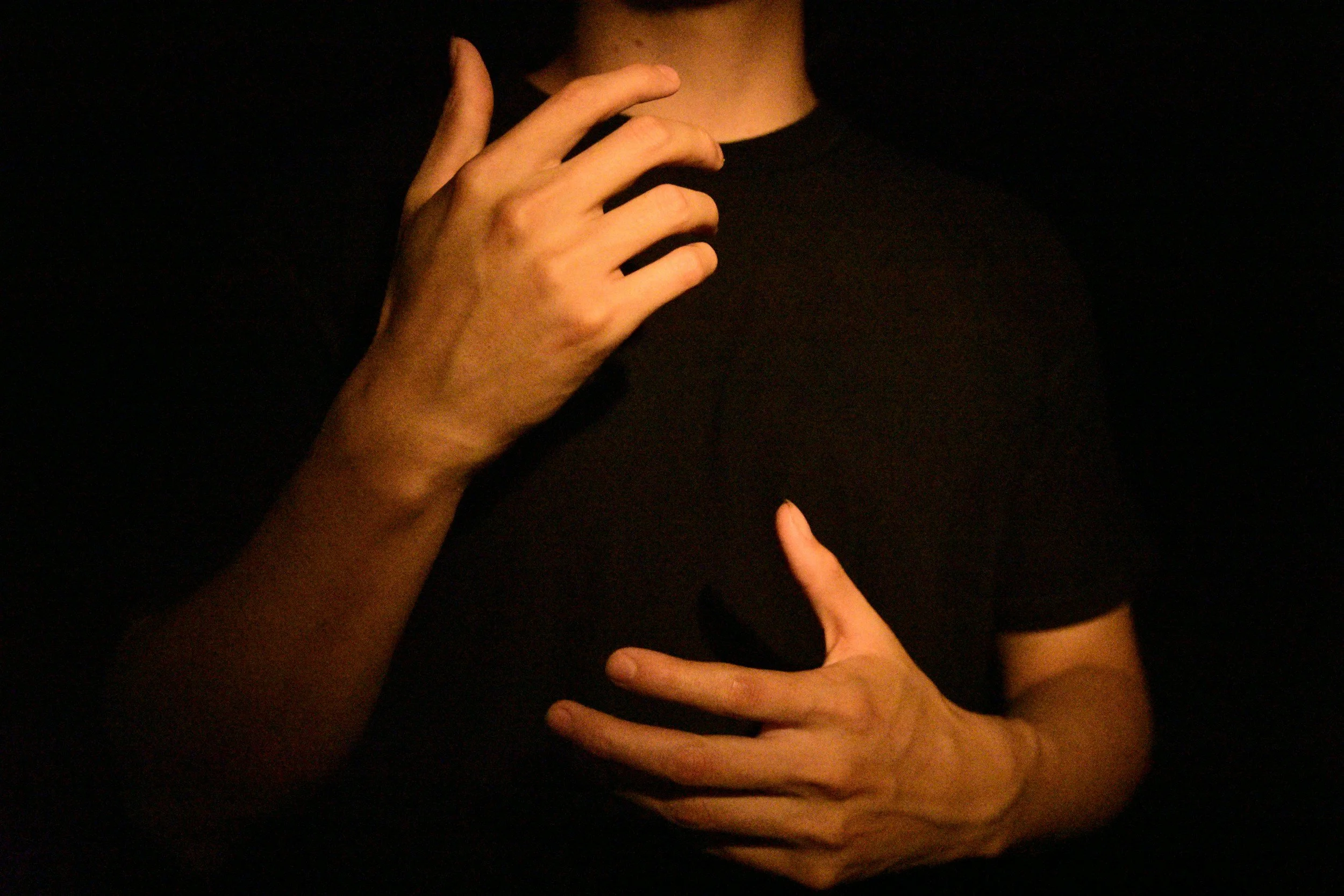
I was raised in an oral home, adopted into a hearing family. My mother wanted me to integrate into the hearing world, not the other way around. I spent most of my life reading lips, learning to hear with hearing aids, and observing people for social cues and interaction.
I learned basic ASL and the alphabet at a deaf camp in my teens, but I forgot most of it from lack of use. The places I lived and the circles I moved through didn’t really have deaf culture available to me. Years later, in college, I took ASL again. Around that same time, I also received a cochlear implant.
I experienced rejection at some deaf gatherings because of my limited ASL skills and because I used a device some people viewed as “fixing a problem.”
There’s nothing to fix. I’m not broken, nor is there a problem. It’s as much a “problem” as having eyes and being able to see. I cannot help but see the world when I look at it. Being deaf is no different. You simply move through the world differently — and just as adeptly. Growing up deaf taught me how to turn challenges into sucess.
It’s easy to get lost in a world that constantly demands conformity or sacrifice at its convenience. When you’re young, some of us go through a crucible just to make it to the other side. The struggles of public school, adolescence, and people who challenge your existence slowly fade as you grow older. By college, the challenge becomes educational instead of social, and in that environment it becomes much easier to learn and grow.
I’ve always loved trying to learn languages. As someone who frequently travels to Spanish-speaking places, it can be difficult trying to read lips and listen in Spanish when so much effort already went into learning how to navigate English. But out of respect for other cultures, I always wanted people to know I was trying. I wanted to speak to people in their way, even if I had limitations.
I suppose that same desire is what pushed me to learn how to communicate with hearing people as effectively as I could. Since people answered my questions, I assumed I spoke clearly enough to be understood.
But perspective changes with time.
Eventually I realized there were many others like me — deaf people raised as hearing. Because I could hear some sound, mostly vowels rather than consonants, I became dependent on that small amount of hearing. As I got older, I wanted to hear more sound. I wasn’t trying to fix myself. I was already happy with who I was.
But when I received the cochlear implant, I wasn’t prepared for the world of sound that followed. The years spent learning to hear, interpret, and understand took enormous work and patience. Today, I cannot imagine not using it.
I’m not even sure why I was so motivated to hear more sound in the first place. Music was a huge part of my life in the 1990s. I happened to be in the right place at the right time for the Pacific Northwest music scene. But what would I really gain from hearing more?
Well… far more than I expected.
I’ve been able to call emergency services. I’ve understood people more easily. I’ve heard sounds I never imagined I would hear.
I embrace the uniqueness of standing between both the hearing and deaf worlds.
As I’ve gotten older, though, I’ve realized how underdeveloped my connection to deaf culture really is. In many ways I still feel like an outsider, despite being clinically 100% deaf. At the same time, I want to help deaf people experience the things I’ve loved in the hearing world — while also hoping they can help me experience what exists in theirs.
I want to experience the things I experience with hearing friends that I rarely seem to find deaf people out doing together:
surfing, camping, traveling, road trips, exploring.
So I started asking questions.
How many deaf surfers are actually out there?
There are probably tens of thousands of deaf and hard-of-hearing surfers worldwide. But the number of culturally Deaf surfers actively connected to the Deaf community is likely much smaller.
Surfing itself is already a niche activity. Estimates place the number of surfers worldwide around 35 million people — less than half of one percent of the global population. If there are roughly 70 million deaf people worldwide, and even a tiny fraction surf regularly, that could still mean tens of thousands of deaf surfers globally.
So where are they?
The reality is that the number of deaf surfers with consistent access to beaches, transportation, instructors, interpreters, affordable equipment, adaptive support, and a welcoming surf culture is probably dramatically smaller.
That realization is one of the reasons I started Silent Wave Project.
Surfing is something deaf people should get the opportunity to experience at least once.
Right now, I’m learning how to teach surfing using ASL. Eventually I want to learn how to talk about camping, traveling, and adventure in ASL too. Hopefully that journey leads to fluency.
I want to learn from you as much as I hope I can teach you surfing. I want to connect with people who are more like me, ive already proven to the hearing world i can exist in their world but now its time for me to honor my world and help other deaf and hard of hearing people find stoke in experiencing the ocean the way i have.